How to Improve Credit Score Before Buying a House
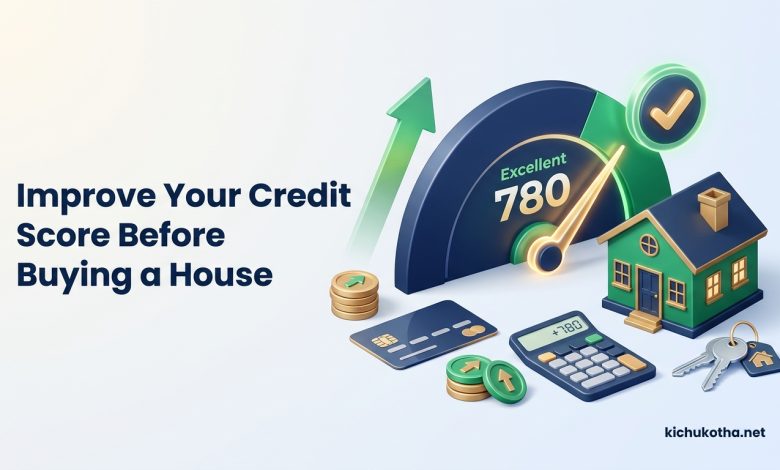
How to Improve Credit Score Before Buying a House: You found a place you love. The kitchen is bright, the street is quiet, and the price is almost reasonable. Then your lender pulls your credit report and everything slows down. It happens to a lot of buyers. Your credit score is one of the first things a mortgage lender looks at, and it affects two big things: whether you get approved, and how much interest you pay for the next 15 or 30 years. A difference of even half a percentage point can add up to tens of thousands over the life of a loan. The good news is that your score is not fixed. If you know how to improve credit score before buying a house, you can often make a real difference in a few months, and sometimes sooner. In this guide, you will learn what score lenders actually want, how long fixes take, the fastest ways to raise your number, and a simple timeline you can follow. We will also look at what people on Reddit and other forums keep asking, so you get straight answers instead of guesswork.
What Credit Score Do I Need to Buy a House?
Let’s start with the question almost everyone asks first. For a conventional mortgage in the United States, most lenders want a minimum score of 620. For an FHA loan, you can qualify with a score as low as 580 with a 3.5% down payment, or 500 to 579 with 10% down. VA and USDA loans have no single official minimum, but many lenders look for around 620 to 640. Those are minimums, though, and a minimum is not the same as a good deal. Lenders price loans based on risk. The higher your score, the lower the interest rate they will usually offer.
Read Also:
- How Much Is Renters Insurance in California? (2026 Cost Guide)
- Affordable Auto Insurance in Texas: How to Pay Less Without Cutting Corners
- Low Interest Personal Loan: How to Find, Qualify For, and Get the Best Rate
- How Much Money Should I Save Before Buying a House?
Credit score ranges at a glance
Most mortgage lenders use FICO scores, which run from 300 to 850. Here is a rough guide to how lenders see each range:
- 800 to 850: Exceptional. You will likely see the best rates available.
- 740 to 799: Very good. Excellent pricing in most cases.
- 670 to 739: Good. Approved by most lenders, but not always at the lowest rate.
- 580 to 669: Fair. Approval is possible, often with FHA loans or higher rates.
- 300 to 579: Poor. Approval is difficult and usually requires a larger down payment.
What is a good credit score to buy a house?
If you want a simple target, aim for 740 or higher. That is the zone where many lenders stop charging you extra for credit risk. You can absolutely buy a home with less. You will just pay more for the privilege. One note for readers outside the United States: the scoring systems differ. In the UK, lenders use agencies like Experian, Equifax and TransUnion with their own scales. In Canada, scores run from 300 to 900. In Australia and India, you will see different bureaus and ranges again. The principles in this article still apply everywhere: pay on time, keep balances low, avoid unnecessary new debt, and check your reports for mistakes.
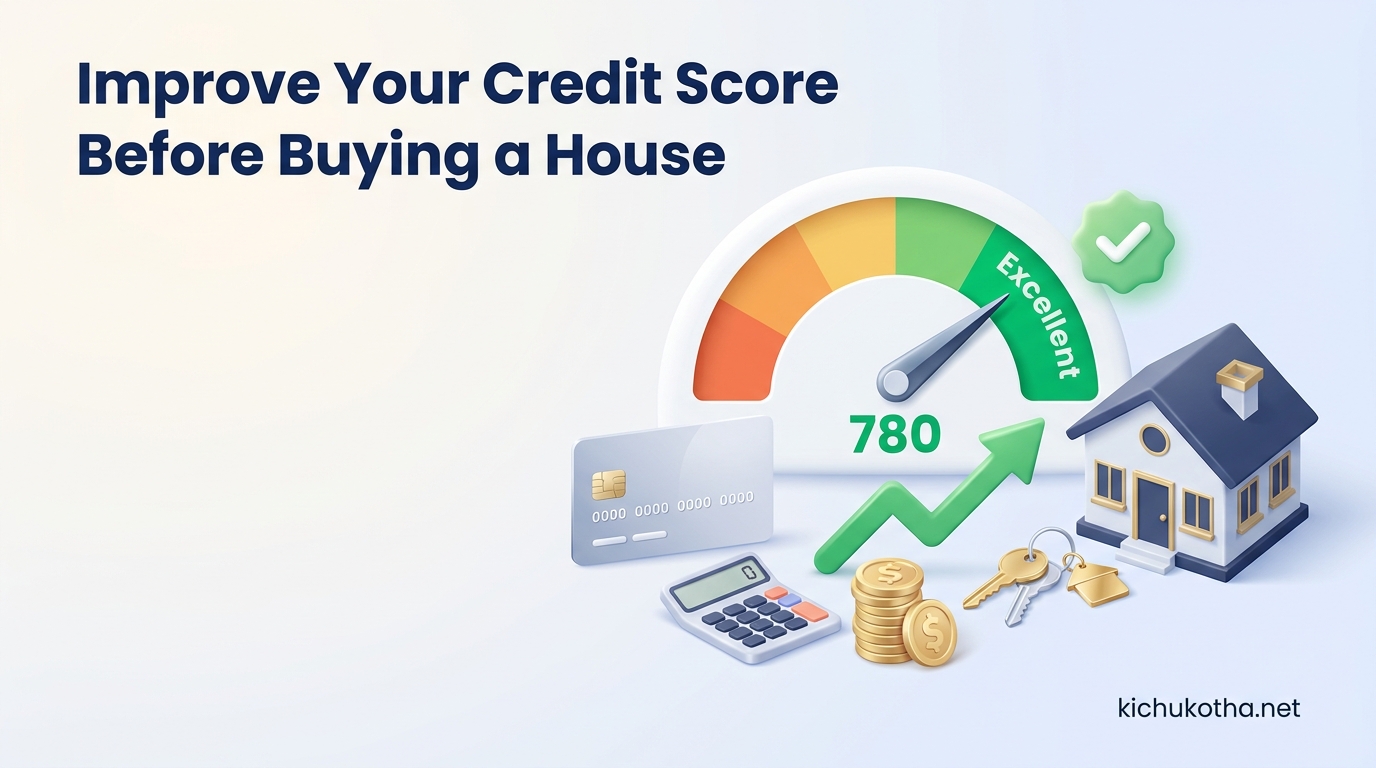
How Your Credit Score Is Actually Calculated
Before you try to raise a number, it helps to know what moves it. The FICO model weighs five factors:
- Payment history (35%). Do you pay on time? This is the biggest piece.
- Amounts owed (30%). This includes your credit utilization, which is how much of your available credit you are using.
- Length of credit history (15%). Older accounts help.
- New credit (10%). Recent applications and newly opened accounts.
- Credit mix (10%). A blend of cards, installment loans and so on.
Notice that two factors, payment history and amounts owed, make up about 65% of the score. If you only have a little time, those are the two places to put your energy.
Step 1: Get Your Credit Reports and Read Every Line
The first step in how to improve credit score before buying a house is not paying anything off. It is looking at what is actually on your reports.
In the United States, you can pull free reports from all three bureaus (Equifax, Experian and TransUnion) at AnnualCreditReport.com. The bureaus currently allow free weekly access, so there is no reason to skip this.
Go through each report slowly. Look for:
- Accounts you do not recognize
- Late payments you know you made on time
- Balances that look wrong
- Accounts that should have closed but still show as open
- Old collections or debts that have passed the reporting time limit
- Mistakes in your name, address or employer
Errors are more common than people think. If you find one, file a dispute directly with the credit bureau online and include any proof you have, like a bank statement or a letter from the lender. Bureaus generally have about 30 days to investigate. Fixing a real error can lift a score quickly, and it costs nothing.
Step 2: Pay Every Bill on Time, Starting Today
Payment history is the heavyweight of your score. One payment that is 30 days late can drop a good score by a noticeable amount, and it can stay on your report for up to seven years.
So the rule is simple: from today until your mortgage closes, do not miss a single payment.
A few things that make this easier:
- Turn on autopay for at least the minimum on every account.
- Set calendar reminders a few days before due dates.
- Call your lender early if you are about to fall behind. Some will work out a plan before it hits your report.
If you already have a recent late payment, you can try a goodwill letter. This is a polite request asking the lender to remove the late mark as a favor, especially if you have a long history of on-time payments. It does not always work, but it costs you a stamp and a few minutes.
Step 3: Lower Your Credit Utilization (The Fastest Way to Increase Your Credit Score)
If you are searching for the fastest way to increase your credit score, this is usually it. Credit utilization is the percentage of your revolving credit limits that you are using. If you have a card with a $5,000 limit and a $2,500 balance, your utilization on that card is 50%. General guidance is to stay under 30%, but people with the highest scores often stay under 10%. The nice thing about utilization is that it has no long memory. Pay down a balance, and once the lender reports the new number, your score can respond within a month or so.
Practical ways to lower utilization
- Pay the balance before the statement date. Cards typically report your balance to the bureaus once a month, often on the statement closing date. If you pay down the balance before that date, a lower number gets reported.
- Pay more than once a month. Small mid-cycle payments keep the reported balance down.
- Ask for a credit limit increase. A higher limit with the same balance means lower utilization. Ask whether the lender will do it without a hard inquiry.
- Spread balances around. Having one card at 90% hurts more than having three cards at 30%.
- Do not close old cards while you are preparing to buy. Closing a card lowers your total available credit and can push your utilization up.
Here is a quick example. Say you have $10,000 in total credit limits and carry $6,000 in balances, so you are at 60%. If you pay $3,500 down, your balance is $2,500 and your utilization drops to 25%. For many people, that single change can move the score by dozens of points.
Step 4: Handle Collections, Old Debts and Past Mistakes
Collections can feel scary, but they are not always a dealbreaker. How you handle them matters.
- Check if the debt is valid. You have the right to ask a collector to validate the debt in writing.
- Ask about a pay-for-delete. Some collectors will agree to remove the account from your report in exchange for payment. Get it in writing before you pay anything.
- Know the rules on medical debt. The bureaus have changed how they handle medical collections in recent years, including removing paid ones and holding off on small balances. Check your own reports to see what applies.
- Be careful with very old debts. In some places, making a payment on an old debt can restart the clock on how long it can be reported or collected. Look up your local rules before paying.
More serious events like bankruptcy or foreclosure carry mandatory waiting periods before most mortgage programs will approve you again. The waits vary by loan type and circumstances, and they are often shorter for FHA loans than for conventional ones, so ask a loan officer about your specific timeline.
Step 5: Avoid New Credit While You Shop for a Home
Every time you apply for new credit, a lender does a hard inquiry. One inquiry usually costs only a few points, but several in a short time, plus a new account lowering your average account age, can add up.
Between now and closing:
- Do not open new credit cards.
- Do not finance a car, furniture or appliances.
- Do not co-sign a loan for anyone.
- Do not make large purchases on credit, even if you plan to pay them off.
Yes, it is tempting to buy the new couch. Wait until after closing. Mortgage shopping is the exception. Scoring models treat multiple mortgage inquiries within a short window (commonly 14 to 45 days depending on the model) as a single inquiry, so you can compare lenders without wrecking your score. Do your rate shopping inside that window.
How Long After I Fix My Credit Can I Buy a House?
This is one of the most common questions, and the honest answer is: it depends on what you fixed.
- Credit report errors: Often 30 to 60 days once the bureau corrects them.
- High credit card balances: One to two billing cycles after you pay them down.
- A single late payment: The damage fades gradually. The score impact is biggest at first and eases over months, though the mark can stay for seven years.
- Collections and charge-offs: Several months to a couple of years to see strong recovery, depending on how you handle them.
- Bankruptcy or foreclosure: Mandatory waiting periods apply, often measured in years.
Also, lenders do not just look at your score the day you apply. They want to see a steady, recent pattern of on-time payments. Many loan officers like to see at least six to twelve months of clean history after a major problem. If you can wait, that time pays off.
How to Increase Credit Score in 1 Month (and by 20 Points)
Can you really make progress in 30 days? Sometimes, yes. It depends on where you are starting from.
If you want to know how to increase credit score by 20 points, the most likely path is:
- Pay down card balances so your utilization drops below 30%, then closer to 10% if you can.
- Dispute errors that are dragging your score down.
- Become an authorized user on a family member’s older account that has low balances and a clean record. The account history may show on your report, though not every scoring model counts it the same way.
- Ask for a limit increase on cards you already have in good standing.
- Make sure nothing is reported late by paying any past-due accounts immediately.
If you are starting with high balances or reporting mistakes, 20 points in a month is realistic. If your score is already in the high 700s, small changes are harder. The closer you are to 850, the less each action moves you. Be wary of anyone who promises to raise your score by 100 points in a week. Those promises usually come from credit repair companies or scams. There is no secret trick that replaces paying on time and keeping balances low.
How to Increase Credit Score to 800
You do not need an 800 to buy a house. But if you are curious about how people get there, the pattern is pretty consistent:
- A long record of on-time payments, ideally with no lates in many years
- Utilization in the low single digits
- An older average account age, which means keeping your oldest cards open
- A healthy mix of credit, such as a card and an installment loan
- Very few hard inquiries
There is no shortcut. Reaching 800 is mostly the result of habits repeated over time. If you are early in your journey, treat 740 as your real goal for mortgage purposes. Beyond that point, the extra savings on rates are usually small.
What Reddit Says About Improving Credit Before a Mortgage
If you search for how to improve credit score before buying a house reddit threads, you will see the same advice come up again and again. Here is the short version of what real buyers tend to share:
- “Pay down your cards before the statement date.” This is the most repeated tip, and it is correct.
- “Do not close old accounts.” Closing cards can hurt your utilization and your average account age.
- “Do not apply for anything new.” Many buyers say they wish they had held off on the car loan.
- “Talk to a loan officer early.” Many say they got the most useful advice months before they were ready to buy.
- “Do not trust expensive credit repair services.” Most of what they do, you can do yourself for free.
A word of caution: Reddit is a good place to see real experiences, but every credit file is different, and posts can be out of date. Treat forum advice as a starting point and confirm the details with your lender or a HUD-approved housing counselor.
A Simple 6-Month Timeline Before You Apply
If you have time, here is a calm, practical way to lay it out.
Six months out
- Pull all three credit reports and dispute errors.
- Set up autopay on every account.
- List your debts, balances and limits.
Four months out
- Start paying down the highest-utilization cards.
- Contact collectors if you have open accounts.
- Stop all new credit applications.
Two months out
- Keep balances low, ideally under 10% to 30% utilization.
- Gather income documents, bank statements and tax returns.
- Talk to a lender for a pre-qualification.
One month out
- Do not change jobs, move money around in odd ways, or open accounts.
- Pay balances before statement dates.
- Get pre-approved and shop rates within a short window.
After you apply
- Keep paying everything on time.
- Do not buy furniture or a car until after closing. Lenders often re-check your credit just before closing.
Frequently Asked Questions
What is the fastest way to improve my credit score before applying for a mortgage?
Pay down your credit card balances to lower your utilization, and dispute any errors on your credit reports. These two steps can show results within one to two billing cycles.
Can I really raise my credit score 20 points in one month?
It is possible if you have high utilization or errors on your reports. Paying balances down before the statement date is usually the most direct way to see a quick bump. Results vary depending on your starting point.
What credit score do I need to buy a house with a low down payment?
FHA loans allow a 3.5% down payment with a score of 580 or higher. Some conventional programs allow 3% down, but they usually require a score of at least 620. Better scores generally mean better rates and lower mortgage insurance costs.
Will checking my own credit hurt my score?
No. Checking your own reports is a soft inquiry and does not affect your score. A hard inquiry only happens when a lender checks your credit because you applied for something.
Is it better to pay off a card or keep it open?
Pay the balance down, but keep the account open if it has no annual fee. An open account with a zero balance helps your utilization and your account age.
Conclusion: Start Early and Stay Consistent
Knowing how to improve credit score before buying a house comes down to a handful of habits: check your reports, pay on time, bring your balances down, avoid new debt, and give the changes a little time to show up. You do not need a perfect score. You need a better one than you have today, and a plan to get there. Even small improvements can lower your interest rate and save you real money every month.
Your next step: Pull your free credit reports today and write down your current score, your total balances, and your credit limits. Then pick one action from this guide, like setting up autopay or paying down your highest card, and do it this week. When you are ready, talk to a mortgage lender or a HUD-approved housing counselor about the best loan for your situation.
Disclaimer: This article is for general education and is not financial advice. Credit scoring rules, loan requirements and waiting periods vary by country, lender and loan program, so confirm the details with a qualified professional.