How Much Money Should I Save Before Buying a House?
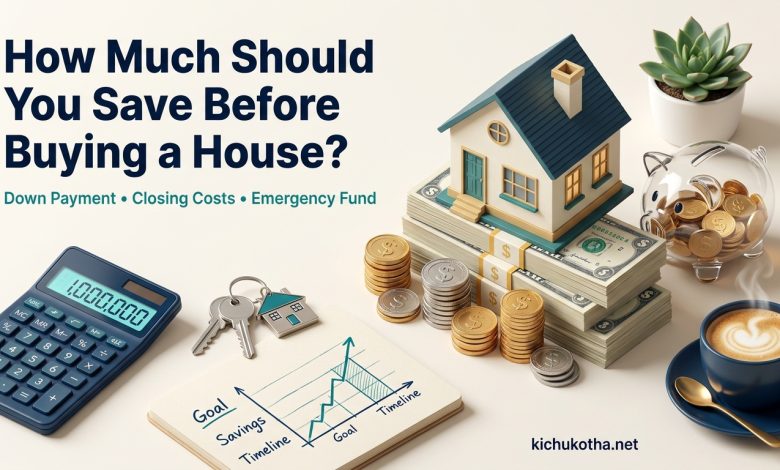
How Much Money Should I Save Before Buying a House: Almost all first-time house hunters ask themselves how much money should I save before buying a house? The answer you will find on an internet search is usually ‘20% down’ and misses a lot. Many people buy a home with far less than 20% down, while many people who save 20% end up struggling a month after closing. The right number depends on the home’s price, your loan type, your closing costs, and how much cushion you need afterwards. This article goes into each of these areas, providing estimates with real examples, such as a $250,000 and a $300,000 house, so you can build a savings target that fits your situation. Most buyers should save 10% to 15% of the price of the home for down and closing costs plus a three- to six-month cushion in emergencies. That’s $35,000 and $55,000 in total on a $300,000 home, that usually means somewhere between $35,000 house. You can buy with less than that, but the smaller your cushion, the tighter your first year will be.
Read Also:
- How Much Is Renters Insurance in California? (2026 Cost Guide)
- Affordable Auto Insurance in Texas: How to Pay Less Without Cutting Corners
- Low Interest Personal Loan: How to Find, Qualify For, and Get the Best Rate
The Short Answer: What ‘Enough’ Savings Actually Means
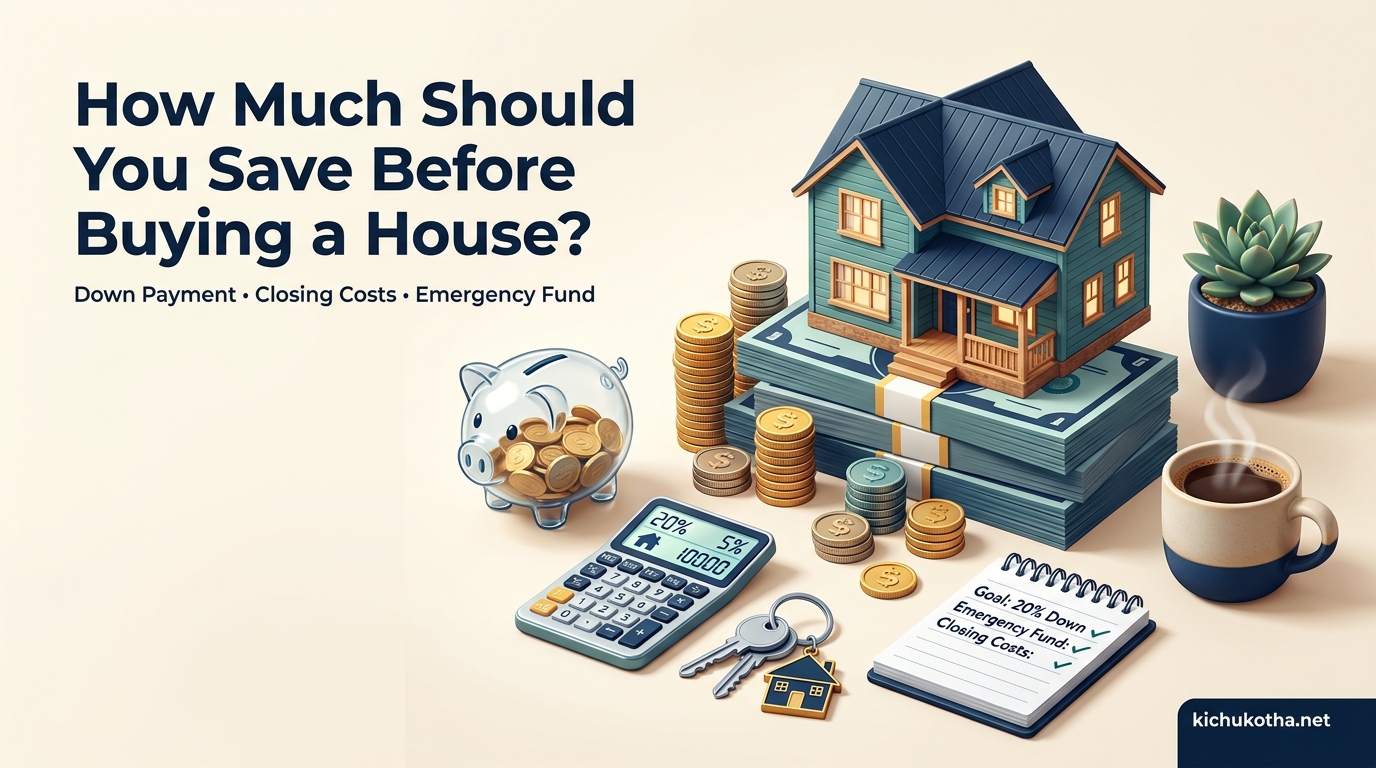
When most people ask how much money they should have to buy a house they usually just mean the down payment, but a purchase draws on four areas of cash:
- Down payment: what you put on the counter for the price of the home
- Closing costs: all the charges required to finalize and transfer the loan, including the title transfer
- Moving and immediately necessary expenses: things like hire a mover, clean and repair the new place
- Emergency fund: money not used in the above categories, left in an accessible account after the purchase of the home
If you just consider one of these, the others can be overwhelming. A realistic savings target covers all of them.
How Much Do You Need to Save for a Down Payment?
The 20% rule: what it means, and when you don’t need it
The 20% number became entrenched because private mortgage insurance (PMI) is usually required for any lower amount on a conventional loan, while a 20% deposit cancels PMI and drops the mortgage rate slightly, with an increase in monthly equity. But it is simply a recommendation. Analysis by the National Association of Realtors has consistently shown that the average first-time buyer puts down just 9% to 10%, while those buying again tend to put in more, partly because they’ve built up equity in their previous home.
Minimum down payments by loan type
These are the minimums typically expected in the United States:
| Loan type | Typical minimum down payment | Notes |
|---|---|---|
| Conventional (standard) | 5% | PMI usually applies under 20% |
| Conventional (first-time buyer programs) | 3% | Income limits usually apply |
| FHA loan | 3.5% | Needs a credit score of about 580 or higher |
| VA loan | 0% | For eligible veterans and service members |
| USDA loan | 0% | For eligible rural and suburban areas |
Lenders and programs set their own targets, so confirm the details with your lender before making any firm target.
Is a bigger down payment always better?
Not necessarily. While it does reduce your monthly payment and the overall interest, having less in the bank to cover immediate and unexpected costs after the move can be a strain. Many personal finance experts would advise a moderate down payment (with PMI if needed) plus an emergency fund over a big down payment and little cash for the immediate future.
Don’t Forget About Closing Costs
These are the charges levied at closing and are usually 2% to 5% of the purchase price, depending on your area and loan type.
What they can include:
- Loan origination and underwriting fees
- Appraisal and home inspection
- Title search and title insurance
- Attorney or escrow fees
- Prepaid property taxes and homeowners insurance
- Recording fees
On a $300,000 home, closing costs could range from $6,000 to $15,000. Sometimes part of this will be subsidised by the seller – never count on this when budgeting your requirements.
The Emergency Fund You Need After Closing
This area of cash in reserve is what many first-time buyers miss, as you are on your own in your home, and the roofer, plumber and electrician are not as easily dealt with as if you had been renting. What can you buy and how much you spend depends on your personal preference, but a good rule of thumb is to have three to six months of essential expenditure in a savings account following your purchase. So if you normally spend around $4,000, that’s $12,000 up to around $24,000 set aside. Some people also budget 1% of the home’s value per year for maintenance, which is $3,000 if you buy a $300,000 home.
How Much Money Should I Have Saved to Buy a $300K House?
Let’s take a realistic example and apply it to a real estate purchase. We’ll say you are buying a $300,000 house for cash with a 5% down conventional loan.
| Expense | Estimated cost |
|---|---|
| Down payment (5%) | $15,000 |
| Closing costs (about 3%) | $9,000 |
| Moving and immediate repairs | $3,000 |
| Emergency fund (3 months at $4,000) | $12,000 |
| Total | $39,000 |
Now let’s see what other deposit levels would mean, excluding the closing costs and reserves:
- 3.5% down (FHA): $10,500
- 5% down: $15,000
- 10% down: $30,000
- 20% down: $60,000
If you choose to put $60,000 towards the deposit on this $300,000 house, your savings target increases to around $80,000 or more once you add closing costs and an emergency fund. If you chose 3.5% down with an FHA loan, the all-in number might be closer to $35,000, although your monthly home fees would likely rise due to mortgage insurance. So, if you are asked how much you should have to save for a 300K home, a realistic amount for many is between $35,000 to $55,000, with $80,000 for those considering 20%.
How Much Should I Have Saved to Buy a $250K House?
And another example at a lower house price. Let’s say we want to buy a $250,000 home with a 5% down conventional loan.
| Expense | Estimated cost |
|---|---|
| Down payment (5%) | $12,500 |
| Closing costs (about 3%) | $7,500 |
| Moving and immediate repairs | $2,500 |
| Emergency fund (3 months at $3,500) | $10,500 |
| Total | $33,000 |
Other down payment levels on a $250K home:
- 3.5% down: $8,750
- 10% down: $25,000
- 20% down: $50,000
So a realistic all-in target would be around $250,000 home is roughly $30,000 to $45,000 for a $250K home, depending on your loan and how large a safety net you want.
How Much to Save for a House as a First-Time Buyer
If you are buying as a first-time buyer, you may have some advantages. There are a number of programmes for first-time buyers aimed at helping those who have little deposit saved.
Assistance programmes: There are many down payment assistance programmes in states, cities and from private trusts that give help, sometimes for qualifying first-time buyers who have completed a home-buying course.
Low-down-payment loans: FHA and some conventional loans allow you to put as little as 3% down.
Gift funds: Many programmes allow gifts towards a down payment, with a note saying it is a gift from a family member.
There is a caveat regarding the benefits to first-time buyers, which is not that you should buy with 3% if it means you have nothing in the bank. A first-time buyer with a slightly smaller first deposit and good emergency fund is a far safer prospect than one with the minimum and nothing else.
How Much Should I Save for a House Each Month?
Once you know the number, it’s simple division to calculate how much you should save for a house per month. Divide the total amount you need by the number of months until you plan to buy.
Using the $39,000 target from the $300K example:
| Timeline | Monthly savings needed |
|---|---|
| 1 year | $3,250 |
| 2 years | $1,625 |
| 3 years | $1,083 |
| 4 years | $813 |
| 5 years | $650 |
These figures don’t include the boost of earnings from compound interest, so keep this in mind if you keep your savings in a high-yield savings account rather than a cash ISA or similar.
Tips to meet your monthly target
- Automate it: Set a standing order on your salary to go directly to your savings account so you don’t spend any of it.
- Keep it separate: Have your house fund in a different bank account from your everyday spending money so you can’t spend it.
- Windfalls: Any lump sum windfall, such as a tax refund, bonus, or income from a side job, can boost your savings significantly.
- Cut one big bill: Paying less per month on a car, or cutting out the cost of subscriptions can have a bigger impact on your savings than numerous little changes.
- Save 20% if you can: Saving a fifth of your salary is a good target if you can achieve it.
Using a House Savings Calculator
Many websites offer a how-much-to-save-for-a-house calculator that can help you come up with a realistic figure in next to no time. You will usually be asked to provide:
- Your desired home price
- Your proposed or current down payment level
- Your estimated closing costs
- Your goals in terms of how much you already have in savings
- Your planned date of purchase
Many websites offering mortgage and house hunting resources offer these calculators for free, including Zillow, which also includes an affordability calculator. If you’re unsure of how much house you can afford, using one of these is a good step. Zillow can show you the homes currently listed in your area, which is a far better place to look than just a random guess.
When using a calculator, keep in mind that it only knows what you tell it, so double-check the figures for your property tax and insurance, and the assumptions for PMI costs if you need it. These can vary greatly depending on where you buy and the details of your loan.
How Much Did Other People Have Saved Before Buying a House?
It can be reassuring to know where you stand compared with other buyers. Research by the National Association of Realtors has found some useful averages:
- First-time buyers: Typically put down between 9% to 10% of the purchase price.
- Repeat buyers: Typically put down 20% or more of the purchase price, as they often have equity from a previous property purchase.
- Many first-time buyers put down their personal savings, sometimes combined with family gifts or assistance programmes.
If you ask your friends or family, how much they had saved before buying, you could hear a whole range of figures, from “almost nothing” to “more than 20%”. Stories are good, but you should remember that home prices and loan programmes change over time. What worked for someone ten years ago may not apply to you, but use these averages as a starting point.
Indicators You Are Financially Ready to Buy
Having the cash is only one consideration and there are other elements to be assessed before touring properties and making offers.
- A stable income. Lenders are looking for at least two years of employment verification.
- A good credit score. Better rates for higher scores – anything more than a few hundred extra per year is worth saving for.
- A healthy debt-to-income ratio. Most lenders look for less than 43% of gross income as monthly commitments towards debt.
- A comfortable monthly payment with space to breathe. Many people suggest 28% or less of gross monthly income should be spent on housing costs.
- No high-interest debt. Paying this off should take priority over buying a house.
If most of the above apply to you and your savings are coming on track, you could well be ready.
Frequently Asked Questions
How much money should I have to buy a house?
Plan for a down payment of between 3.5% to 20%, plus closing costs of 2% to 5% and an emergency fund covering three to six months of expenses. Most buyers need to set aside 10% to 15% of the price of the home for these up-front costs.
Do I really need 20% down?
No, most buyers put down 3% to 10% for first-time purchase, but you may pay more to get a lower rate on your mortgage.
How much should I save for a house each month?
It depends how long you have until you plan to buy, but divide the amount you want by the months you have. For a $39,000 goal over three years, that’s about $1,083 a month. A good rule of thumb is to save as much of your income as you can without sacrificing your emergency fund or retirement contributions.
Should I save for a house or pay off debt first?
It depends on the debt. Paying off credit cards or other high-interest debt should take priority. Low-interest debt, such as a student loan with a low APR, should be repaid as scheduled.
How long does it take to save for a house?
It varies depending on your income, but as an example, saving $300,000 home, that usually means somewhere between $0__36,000 in three years and with assistance programmes and family help can make this faster. You could have three years until you move, but saving $300,000 home, that usually means somewhere between $1__1,083 each month if you want to buy a $300,000 home.
A Note for Buyers Outside of the United States
Many of the figures discussed are based on United States figures, but the same four-bucket system applies anywhere. The minimum deposits vary by country, with deposits for Canada starting at 5% on some lower-priced homes. Minimum down payments in the UK start at usually 5% for first-time buyers, but you’ll likely get more favourable rates on mortgages with higher deposits. Other costs such as stamp duty, land transfer tax and similar can boost the cost of a purchase significantly. Ask a local lender and researcher if you need information specific to where you are looking to buy.
Conclusion: Build Your Number and Start Saving
So, how much money should you save before buying a house? There isn’t a simple answer, but once you calculate the four areas of expenditure (down payment, closing costs, initial repairs and an emergency fund), you have a realistic goal. For a $300,000 home, that usually means somewhere between $2__250,000 home, it might be $300,000 home, that usually means somewhere between $3__45,000. Divide that by the number of months you have to save and you have your monthly target. Don’t let the myth of 20% keep you from saving and starting, and don’t let the suggestion of 3% keep you from setting a solid emergency fund. The right position is a happy one for many, where you can keep your monthly payments comfortable without sacrificing other important areas of your life. Your next step is to pick a realistic price for your dream home, add it to a money-saving calculator and set up an automatic transfer to your savings. Every little bit really does help. If you are ready to start this process in earnest, speak with a mortgage lender about pre-approval so you know what to expect when house hunting begins.
This article is for informational purposes and should not be treated as financial advice. Loan requirements, rates and fees change frequently, so confirm the latest figures with a licensed mortgage professional.